
AAA Projects Increase in July 4th Week Travel in 2024 Over 2019
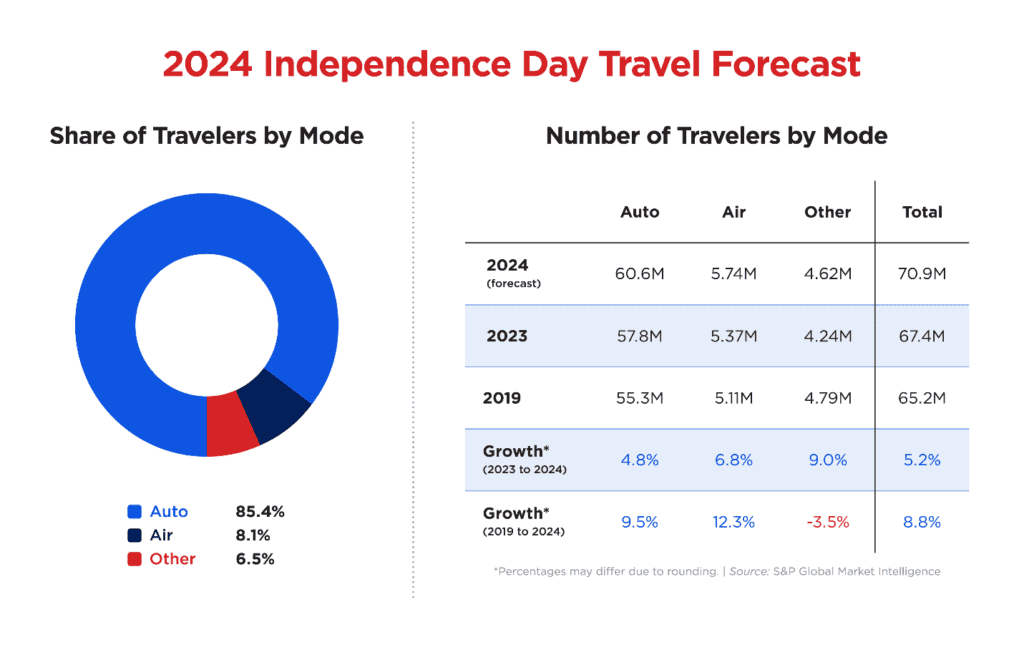
AAA projects 70.9 million travelers will head 50 miles or more from home over the Independence Day holiday travel period. This year’s projected number of travelers for that time period is a 5% increase compared to 2023 and an 8% increase over 2019. AAA Spokeswoman Jana Tidwell says this July 4th week is anticipated to be the busiest ever with an additional 5.7 million people traveling compared to 2019. AAA projects a record 60.6 million people will travel by car over Independence Day week – that’s an additional 2.8 million travelers compared to last year. This year’s number also surpasses 2019 when 55.3 million people traveled by car over July 4th week. Gas prices are lower than last year when the national average was $3.53. Pump prices will likely continue going down leading up to Independence Day. At that point, they will likely level off and remain relatively stable until after Labor Day, similar to last year.
Additional Information from AAA:
For the first time, AAA looked at the entire July 4th week, plus the Saturday before and the Sunday after the holiday.
Flying High
The number of air travelers is also expected to set a new record. AAA projects 5.74 million people will fly to their July 4th destinations. That’s an increase of nearly 7% compared to last year and a 12% increase over 2019. AAA booking data shows domestic airfare is 2% cheaper this Independence Day week compared to last year, and the average price for a domestic roundtrip ticket is $800. Airports will be packed throughout the week. AAA recommends arriving 2 hours early, reserving parking ahead of time, and traveling with carry-on luggage versus checked bags to save time and money.
Other Modes of Travel
More than 4.6 million people are expected to travel by other modes of transportation, including buses, cruises, and trains. This category is seeing an increase of 9% compared to last year, but this year’s number is shy of 2019’s figure of 4.79 million. Cruising continues its remarkable post-pandemic comeback. This time of year, Alaska cruises are in high demand, making Seattle and Anchorage top domestic destinations. Cruise travelers are also finding deals this summer. With new ships coming onto the market – and going for a premium – some cruise lines have been offering targeted discounts to fill older inventory for remaining cabins.
Best/Worst Times to Drive
INRIX, a provider of transportation data and insights, says the worst times to travel by car before and on July 4th are between 2pm and 7pm. Drivers should hit the road in the morning, and travelers returning on Monday, July 8th should avoid rush hour traffic in the morning and afternoon.
“Drivers in large metro areas can expect the worst traffic delays on Wednesday, July 3rd, as they leave town, and Sunday, July 7th, as they return,” said Bob Pishue, transportation analyst at INRIX. “Road trips over the holiday week could take up to 67% longer than normal. Travelers should monitor 511 services, local news stations, and traffic apps for up-to-the-minute road conditions.”
| Best and Worst Times to Travel by Car | ||
| Date | Worst Travel Time | Best Travel Time |
| Monday, Jul 1 | Minimal Traffic Impact Expected | |
| Tuesday, Jul 2 | 2:00 – 6:00 PM | After 7:00 PM |
| Wednesday, Jul 3 | 2:00 – 7:00 PM | Before Noon |
| Thursday, Jul 4 | 2:00 – 7:00 PM | Before Noon |
| Friday, Jul 5 | 11:00 AM – 4:00 PM | Before 10:00 AM |
| Saturday, Jul 6 | 10:30 AM – 2:30 PM | Before 10:00 AM |
| Sunday, Jul 7 | 2:00 – 8:00 PM | Before 11:00 AM |
| Monday, Jul 8 | 1:00 – 5:00 PM | After 7:00 PM |
Source: INRIX
Top Destinations
This July 4th week, travelers are cooling off in the Pacific Northwest and Alaska – and by the ocean! Seattle, Vancouver, and Anchorage are top destinations because of the popularity of Alaska cruises this time of year. Beaches in South Florida, Honolulu, Punta Cana, and Barcelona are in high demand. Historical sites in European cities like London, Rome, Dublin, Paris, and Athens are also popular. The top 10 domestic and international destinations below are based on AAA booking data.
| DOMESTIC | INTERNATIONAL |
| Seattle, WA | Vancouver, BC, Canada |
| Orlando, FL | London, England |
| Anchorage, AK | Rome, Italy |
| Honolulu, HI | Dublin, Ireland |
| Miami, FL | Paris, France |
| New York, NY | Calgary, AB, Canada |
| Fort Lauderdale, FL | Amsterdam, Netherlands |
| Las Vegas, NV | Punta Cana, Dominican Republic |
| Denver, CO | Athens, Greece |
| Anaheim/Los Angeles, CA | Barcelona, Spain |
Family Road Trip Checklist
With road trips expected to set a new record this July 4th week, AAA teamed up with Chicco to share safety tips for families with small children.
- Check car seat fit. Before you hit the road, check your child’s weight and height to ensure they’re in the right seat and mode of use – especially when it comes to transitioning from rear to forward-facing. Children should remain rear-facing as long as possible for better protection of their head, neck, and spine in the event of a crash. If you are unsure which car seat is best for your child, Chicco offers a car seat comparison guide.
- Double check car seat installation. Even if your car seat is already installed in the car, it’s worth checking everything is safe and secure. An easy at-home way to do this is with the “inch test.” Simply grab the seat at the car seat belt path and pull side to side and front to back. If it moves more than one inch in any direction, uninstall and start over until a secure fit is achieved. For any questions, utilize the car seat manual, QR codes, or online resources like those offered by Chicco.
- Secure loose items in the car. Take time to organize and clean up your car before hitting the road. Storage organizers that secure to the back of the driver and passenger seats are simple solutions to make sure everything has a spot, especially loose items that can become projectiles in case of a sudden stop.
- Be prepared for the unexpected. Pack an emergency kit with first-aid supplies, water, snacks, blankets, jumper cables, and flares. Make sure your phone is fully charged – and keep a charger in the car – to call AAA or request roadside assistance digitally if your battery dies, you lock yourself out, or you need a tow.
- Map your route. Families with young children should plan for frequent and longer stops along the way. Map out your route ahead of time with AAA TripTik and browse hotels, restaurants, and other activities along the way on AAA Trip Canvas.
- Bring entertainment. Make sure to place toys and books within reach to keep children entertained. If your kids use tablets or other electronics, make sure the devices are fully charged and pre-downloaded before leaving home. Another fun way to get the whole family excited for the road trip is to create a family playlist of everyone’s favorite songs!
Holiday Forecast Methodology
Travel Forecast
In cooperation with AAA, S&P Global Market Intelligence (SPGMI) developed a unique methodology to forecast actual domestic travel volumes. The economic variables used to forecast travel for the current holiday are leveraged from SPGMI’s proprietary databases. These data include macroeconomic drivers such as employment, output, household net worth, asset prices, including stock indices, interest rates, housing market indicators, and variables related to travel and tourism, including gasoline prices, airline travel, and hotel stays. AAA and SPGMI have quantified holiday travel volumes going back to 2000.
Historical travel volume estimates come from DK SHIFFLET’s TRAVEL PERFORMANCE/MonitorSM. The PERFORMANCE/MonitorSM is a comprehensive study measuring the travel behavior of U.S. residents. DK SHIFFLET contacts over 50,000 U.S. households each month to obtain detailed travel data, resulting in the unique ability to estimate visitor volume and spending, identify trends, and forecast U.S. travel behavior, all after the trips have been taken.
The travel forecast is reported in person-trips. In particular, AAA and SPGMI forecast the total U.S. holiday travel volume and expected mode of transportation. The travel forecast presented in this report was prepared the week of May 27, 2024.
Because AAA forecasts focus on domestic leisure travel only, comparisons to TSA passenger screening numbers should not be made. TSA data includes all passengers traveling on both domestic and international routes. Additionally, TSA screens passengers each time they enter secured areas of the airport, therefore each one-way trip is counted as a passenger tally. AAA focuses on person-trips, which include the full round-trip travel itinerary. As a result, direct comparisons of AAA forecast volumes and daily TSA screenings represent different factors.
*Independence Day Holiday Travel Period
For this forecast, the Independence Day holiday travel period is defined as the nine-day period from Saturday, June 29 to Sunday, July 7. Historically, the Independence Day holiday period included only one weekend. This is the first year the Independence Day holiday travel period is a longer timeframe with two weekends included.