
Stranded Seal from Ocean City – Rehabbed & Released at Assateague Thursday
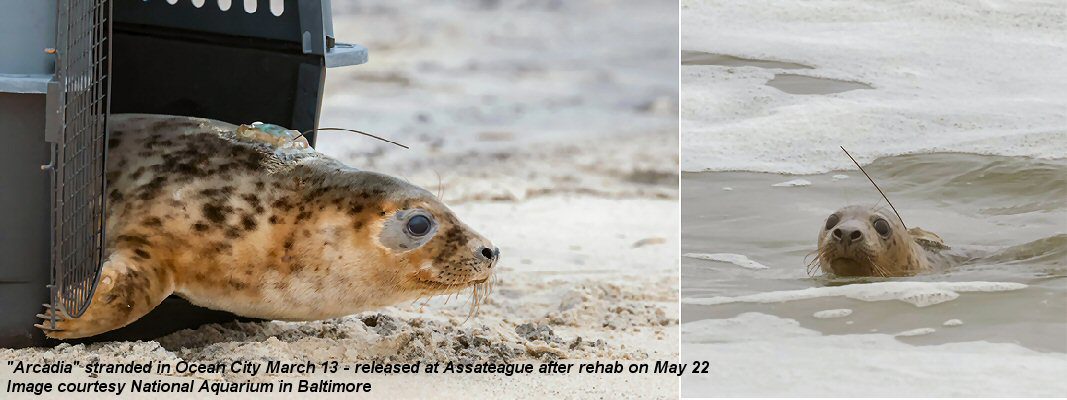 “Arcadia,” a female grey seal was found stranded in Ocean City on March 13 of this year, has been released at Assateague Island State Park on Thursday, May 22. Arcadia underwent initial triage at the National Aquarium’s Stranding Response Center in Ocean City followed by a successful long-term treatment at the Aquarium’s Animal Care and Rescue Center (ACRC) in Baltimore. When she was rescued from the beach in Ocean City, Arcadia was emaciated with evidence of an infected puncture wound, an eye infection and oral trauma at just a few weeks old, an age still considered maternally dependent in this species. Arcadia was treated for her injuries and learned to swim and forage for fish independently during her time at the ACRC.
Arcadia, so named for the Baltimore neighborhood adjacent to Herring Run Park in keeping with this year’s animal rescue Baltimore City neighborhoods naming theme, is the youngest seal ever treated and released by the National Aquarium’s Animal Health and Rescue teams. As demonstrated in the assets at the link below, Arcadia was outfitted before her release with a non-invasive satellite tag that will allow experts to track her movement and migration upon release until the tag sheds with her next seasonal molt. The collected data allows Aquarium teams and others to learn more about the habits and patterns of seal species that have established populations along the East Coast.
Currently, two other seals rescued this season—Evergreen and Remington—continue to rehabilitate at the ACRC. An additional two seals—Woodberry and Waverly—were successfully released in April. Before being released, all rescued seals rehabilitated by Aquarium teams must reach a weight of at least 25 kgs; be able to swim, forage and eat independently; and be cleared by stranding partners at the National Oceanic and Atmospheric Administration (NOAA) after a blood test demonstrating the animal is healthy and free of infection.
National Aquarium seal stranding and response activities are conducted under NOAA permit 18786-04.