UPDATED: NTSB Determines a Single Loose Wire in Dali’s Electrical System the Cause of the Collapse of Key Bridge in Baltimore
UPDATED – 11/18/25 – A year and a half after the Container ship Dali collided with the Francis Scott Key Bridge in Baltimore the NTSB has concluded that a thin wire deep in the ship’s electrical system was the cause of the Dali losing power and colliding with the bridge on March 26th, 2024. NTSB Chair Jennifer Homendy said at the start of this morning’s meeting that this didn’t have to happen.
From the MD Transportation Authority: The Maryland Transportation Authority (MDTA) is reviewing the findings and recommendations of the final report made by the National Transportation Safety Board.
The MDTA maintains that the collapse of the Francis Scott Key Bridge and the tragic loss of life were the sole fault of the DALI and the gross negligence of its owners and operators. The Key Bridge was approved and permitted by the federal government and complied with those permits. The Key Bridge Rebuild continues to advance in the design process and will have a rigid fender pier protection system to meet today’s American Association of State Highway and Transportation Officials design standards.
From the NTSB Release: The NTSB said Tuesday that a single loose wire on the 984-foot-long containership Dali caused an electrical blackout that led to the giant vessel veering and contacting the nearby Francis Scott Key Bridge in Baltimore, which then collapsed, killing six highway workers.
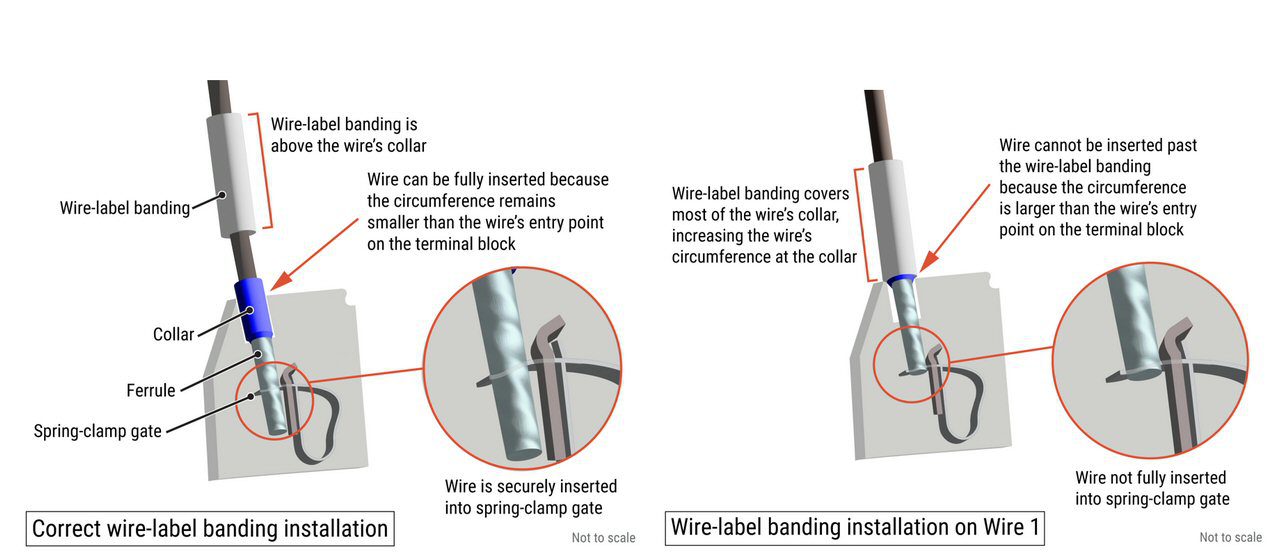
Illustration showing how placement of wire-label banding affects the way wires are seated in their terminal blocks. (Source: NTSB)
At Tuesday’s public meeting at NTSB headquarters, investig
After the initial blackout, the Dali’s heading began swinging to starboard toward Pier 17 of the Key Bridge. Investigators found that the pilots and the bridge team attempted to change the vessel’s trajectory, but the vessel’s loss of propulsion so close to the bridge rendered their actions ineffective. A substantial portion of the bridge subsequently collapsed into the river, and portions of the pier, deck and truss spans collapsed onto the vessel’s bow and forwardmost container bays.
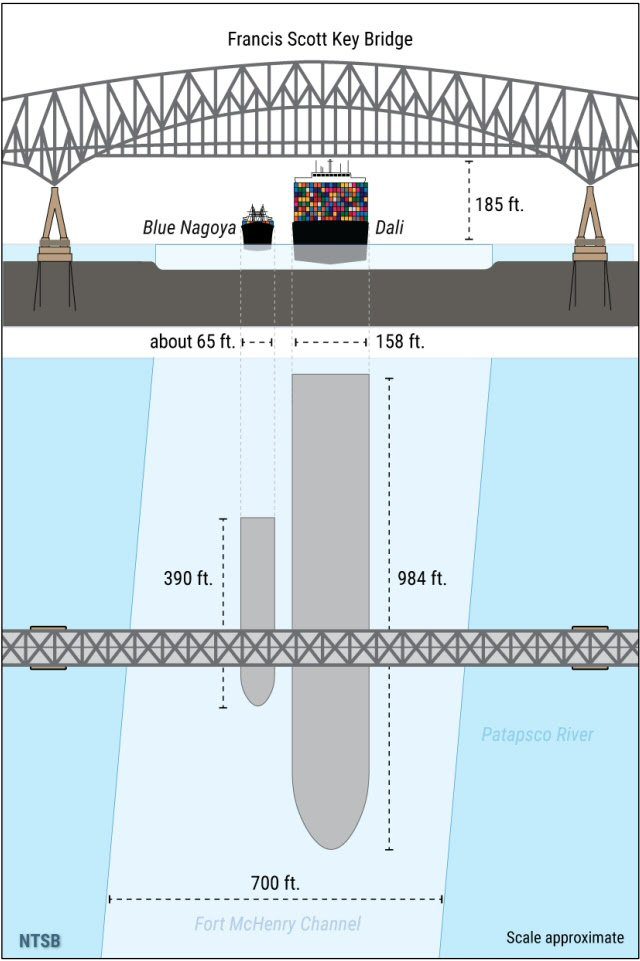
The comparative sizes of the Blue Nagoya and the Dali relative to the Key Bridge. (Source: NTSB)
A seven-person road maintenance crew and one inspector were on the bridge when the vessel struck. Six of the highway workers died. The NTSB found that the quick actions of the Dali pilots, shoreside dispatchers and the Maryland Transportation Authority to stop bridge traffic prevented greater loss of life.
“Our investigators routinely accomplish the impossible, and this investigation is no different,” said NTSB Chairwoman Jennifer Homendy. “The Dali, at almost 1,000 feet, is as long as the Eiffel Tower is high, with miles of wiring and thousands of electrical connections. Finding this single wire was like hunting for a loose rivet on the Eiffel Tower.
“But like all of the accidents we investigate, this was preventable,’’ Homendy said. “Implementing NTSB recommendat
Contributing to the collapse of the Key Bridge and the loss of life was the lack of countermeasures to reduce the bridge’s vulnerability to collapse due to impact by ocean-going vessels, which have only grown larger since the Key Bridge’s opening in 1977. When the Japan-flagged containership Blue Nagoya contacted the Key Bridge after losing propulsion in 1980, the 390-foot-long vessel caused only minor damage. The Dali, however, is 10 times the size of the Blue Nagoya.
As part of the investigation, the NTSB in March released an initial report on the vulnerability of bridges nationwide to large vessel strikes. The report found that the Maryland Transportation Authority—and many other owners of bridges spanning navigable waterways used by ocean-going vessels—were likely unaware of the potential risk that a vessel collision could pose to their structures. This was despite longstanding guidance from the American Association of State Highway and Transportation Officials recommending that bridge owners perform these assessments. The NTSB sent letters to 30 bridge owners identified in the report, urging them to evaluate their bridges and, if needed, develop plans to reduce risks. All recipients have since responded, and the status of each recommendation is available on the NTSB’s website.
As a result of the investigation, the NTSB issued new safety recommendations to the US Coast Guard; US Federal Highway Administration; the American Association of State Highway and Transportation Officials; the Nippon Kaiji Kyokai (ClassNK); the American National Standards Institute; the American National Standards Institute Accredited Standards Committee on Safety in Construction and Demolitions Operations A10; HD Hyundai Heavy Industries; Synergy Marine Pte. Ltd; and WAGO Corporation, the electrical component manufacturer; and multiple bridge owners across the nation.
A synopsis of actions taken Tuesday, including the probable cause, findings and recommendations, can be found on ntsb.gov. The complete investigation report will be released in the coming weeks.
=============================================================================
The National Transportation Safety Board will hold a public board meeting at 9am on Tuesday, November 18 to determine the probable cause of the crash of the container ship, Dali, with the Francis Scott Key Bridge and its collapse on March 26, 2024 in Baltimore. That incident killed six construction crew members working on the bridge and seriously injured one other construction crew member. One crew member on the Dali was also injured. During the meeting, the NTSB’s board will vote on the findings, probable cause and safety recommendations as well as any changes to the draft final report.
The complete final report will be available in several weeks at NTSB.gov.
HOW TO WATCH: If the government is still shut down, NTSB will not be able to livestream and instead will post a recording of the board meeting on NTSB.gov for those who cannot attend in person.