
Daughters of the American Revolution Gifts Liberty Tree to Salisbury University
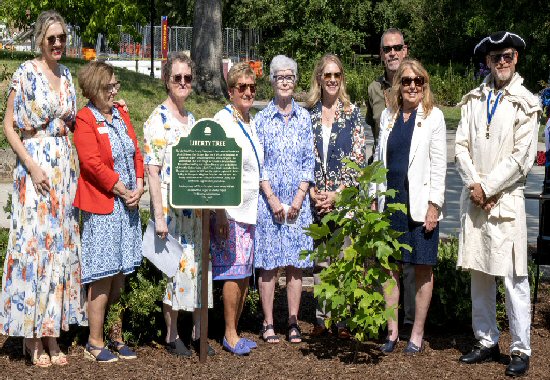
Image courtesy Salisbury University
Salisbury University is one of 13 locations that is now home for a direct genetic clone of the original Liberty Tree that stood at the site of St. John’s College in Annapolis for nearly 225 years. The Annapolis Liberty Tree was removed in 1999 after it was irreparably damaged during Hurricane Floyd.
The Maryland State Society Daughters of the American Revolution (MSSDAR) chose SU as one of 13 planting sites for the descendant of the Annapolis Liberty Tree – it was dedicated Thursday outside the Guerrieri Academic Commons.
Additional information from Salisbury University:
Local MSSDAR chapters involved in the initiative at SU included the General Levin Winder, Nanticoke, and Samuel Chase chapters.
“The Daughters of the American Revolution is committed to historical preservation, education, and patriotism,” said Judy Halter, regent of the Samuel Chase chapter. “This project fulfills all three, and we had hoped to find a location that could fulfill all three. We’re preserving a piece of history with the tree itself. Salisbury University offered us a connection for the educational piece, in addition to educating the public on what Liberty Trees were and what the Revolutionary War was all about. Each time we talk about a topic like this, it helps people realize that they have a choice to help preserve our country.”
“At SU, civic engagement is part of what it means to be a Sea Gull,” said SU President Carolyn Ringer Lepre. “Every student who walks through our doors has the opportunity and the responsibility to be an active and engaged member of their community. Our students learn to ask questions, listen to perspectives different than their own, think critically about the world around them, and, most importantly, realize that they have a role in shaping our world.
“That is what makes this tree such an amazing addition to our campus. Its roots connect us to an important chapter in our nation’s history, while its place here gives that history a living connection to students on our campus today.”
“The Liberty Tree is one of the most powerful and enduring symbols of America’s independence,” said Maryland State Senator and DAR member Mary Beth Carozza during the dedication ceremony. “Having this tree planting here at Salisbury University … will allow us to continue to share our story of the American Revolution, the pathway to America’s liberty, with future generations.”
Liberty Trees were so named because Colonial citizens opposing British tyranny in the mid-1770s chose them as gathering points to discuss their opposition and plan resistance activities. They became so symbolic of Colonial resistance that the original, in Boston, reportedly was felled and burned for firewood by British loyalists in August 1775, just months after the start of the Revolutionary War. Others throughout the American colonies endured.
The placement of the Liberty Tree at SU, near The Square, an iconic student gathering site since the early 1980s, is symbolic of the Liberty Trees’ history as landmarks for gatherings. Its location outside the Guerrieri Academic Commons also ties it to other objects on campus with U.S. historical significance. The facility is home to SU’s Edward H. Nabb Research Center for Delmarva History and Culture, a repository for some of the nation’s oldest genealogical records. The building’s Brown and Church Carillon features two of the final bells produced by London’s renowned Whitechapel Bell Foundry, which also cast the original Liberty Bell in 1752.
In addition to its legacy as the longest-surviving Liberty Tree, the Annapolis tree played a unique role in other parts of the nation’s early history. General George Washington resigned his commission as commander-in-chief of the Continental Army at the Maryland State House on December 23, 1783, in view of the tree’s crown. Several years later, Francis Scott Key walked beneath its branches as a St. John’s College student about two decades before writing The Star-Spangled Banner.
The Liberty Tree seedlings planted as part of the “Our Legacy of Liberty Project” were obtained by the MSSDAR in cooperation with the Allegany County Forestry Board.
At SU, the Liberty Tree is now part of the University’s Glenda Chatham Clarke Arboretum, encompassing the 200-plus-acre campus. The nationally accredited ArbNet Level III arboretum is home to more than 3,000 trees and an extensive inventory of woody and herbaceous plant species.
“As we celebrate our nation’s 250th anniversary, this tree gives us a meaningful opportunity to reflect on the ideals, liberty, civic engagement, and service that have shaped our country,” said Lepre. “I can think of few better places for a Liberty Tree than on a university campus, most especially here at Salisbury University.”