
DE Supreme Court Affirms Court of Chancery Ruling Against Sussex County in US Wind/Renewable Redevelopment Decision
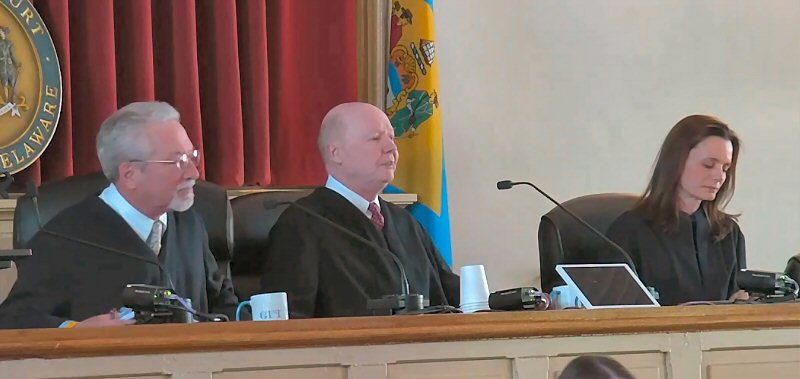
Delaware Supreme Court Justice Gary Traynor / Chief Justice Collins Seitz,Jr. / Justice Abigail LeGrow
The Delaware Supreme Court has affirmed the judgment of the Court of Chancery which dismissed Sussex County’s Claims against the State and Renewable Redevelopment, a subsidiary of US Wind, which is looking to bring four electric cables onshore from a proposed offshore wind project at 3-Rs beach and connect them at an electrical substation near the Indian River Power Plant near Dagsboro.
Attorneys Stephanie Ballard and Jane Brady presented oral arguments before the Delaware Supreme Court last Wednesday arguing that a state statute adopted by the General Assembly that authorized conditional use permits for electrical substations violated the Separation of Powers doctrine in the Delaware constitution.
This appeal came after a Court of Chancery bench ruling that dismissed Sussex County’s claims against the State and US Wind’s Renewable Redevelopment. The opinion by the Delaware Supreme Court overturns Sussex County’s denial of a conditional use application for the substation near Dagsboro.
The Sussex County Council deferred its vote after a public hearing on Conditional Use No 2515 and in Old Business the Council voted 4 to 1 to deny the conditional use application in December of 2024.
That Council’s decision was challenged by Renewable Redevelopment in a petition to the Delaware Superior Court, but not waiting for a ruling, the General Assembly passed SB 159 and SB 199, which negated the permit denial. The Governor signed the legislation that day.
In an opinion released Tuesday, Chief Justice Collins Seitz, Jr. says “we agree with the Court of Chancery’s reasoning on each issue and affirm its summary judgment ruling for the defendants.”
In the opinion, the justices said that, “Sussex County Council denied a permit for the electrical substation. The General Assembly decided that greater interests were at stake and passed legislation that overrode County Council’s permit denial. As the ultimate authority for zoning policy throughout the State, it could do so.”
The justices further stated in the opinion that, “The General Assembly controls the zoning power. Even though it has delegated that power to the counties and municipalities, it has the power to reclaim it and need not defer to the decisions of subordinate governments.”