DNREC Helps Grow Delaware Quail Population Through Targeted Habitat Work
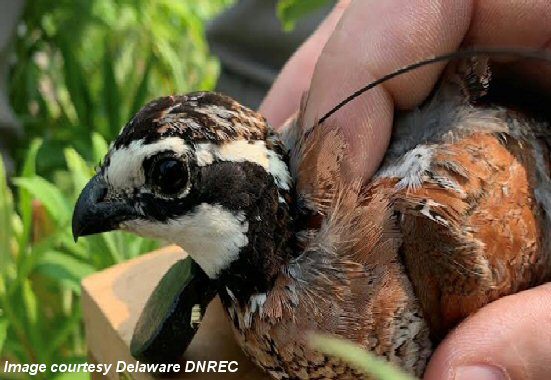 About 15 years ago northern bobwhite quail,which used to be prevalent in Delaware declined in number drastically – mainly due to pesticide use, development and increased predation. DNREC, with help from a University of Delaware study, has worked to increase quail numbers in the Cedar Swamp Wildlife Area along the Delaware River and Bay. Numbering in the dozens 15 years ago the population is around 800 and quail are naturally moving to other areas which are being made ‘habitat friendly’ – like the Marshy Hope Wildlife Area east of Bridgeville where a small number of quail have been detected. DNREC with help from various state and non-profit groups will prepare that location to be a better quail habitat.
Additional information from DNREC:
From the mid-1960s to 2020, the population of northern bobwhite quail saw a precipitous drop in the United States. In a span of a little more than half a century, the species’ numbers’ fell by roughly 80%, according to the U.S. Department of Agriculture. Delaware was no exception.
The only species of quail found east of the Mississippi River once numbered in the tens of millions. Today, the population is down to an estimated 6 million across the country.
Fortunately for Delaware, an initiative launched a decade and a half ago here is already paying dividends for our state.
Around 2009, the Delaware Department of Natural Resources and Environmental Control took some significant steps to improve the species’ survival rates in the First State. DNREC biologists began by examining habitat, aided by a University of Delaware study conducted around the same time that analyzed quail habitats and remaining quail populations.
“Quail are a very habitat-driven species, so if we can bring back the habitat we typically can bring back quail populations,” said Eric Ludwig, a wildlife biologist/habitat program manager with the DNREC Division of Fish and Wildlife.
Northern bobwhite quail, which have one of the largest ranges of any non-migratory upland bird in the country, used to be very densely populated in Delaware. But by the early 21st century, the levels had greatly declined, in large part due to pesticide use, development and increased predation.
As a result of the UD study and biologists’ work, DNREC determined the most promising site was Cedar Swamp Wildlife Area along the Delaware River and Delaware Bay. The area contained a remnant quail population as well as suitable habitat, making it a focal point for the Department and its conservation work.
Northern bobwhite quail prefer grasslands, which provide cover for the species, serve as nests and offer places to forage. Environments with significant amounts of grasses and shrubs, as well as some trees, are ideal for quail to feed, mate and raise their young.
To best serve the species, DNREC worked to uproot nonnative plants, such as autumn olive, and plant native flora. Crucially, the Department also used prescribed fire to clear the landscape. Controlled burns eliminate excess brush and small trees, leaving behind early successional habitat that’s vital for northern bobwhite quail.
Part of the nationwide quail decline, in fact, is attributed to changes in land management, including preventing fires from starting. While flames may seem to pose a danger to wildlife, fire actually has an important role in ecosystems.
Fire acts as the great reset button, clearing built-up brush and thatch that can be a hindrance for some species. Northern bobwhite quail are among those that benefit the most from fires, which often leave behind a landscape that is ideal for the species.
It’s for this reason DNREC strives to set prescribed burns at Cedar Swamp Wildlife Area every year. The Department uses a three-year rotation, burning about one-third of the grass fields each year.
Early efforts brought positive results, and so DNREC expanded south. Today, its quail efforts are concentrated on the Delaware Bayshore, a corridor running from New Castle to just south of Milford.
About 15 years ago, northern bobwhite quail at Cedar Swamp Wildlife Area numbered in the dozens. Today, the population is more like 800 — an order of magnitude greater.
Now, as quail are dispersing naturally from the wildlife area, DNREC’s experts are working to be proactive and manage quail habitat along the Bayshore so the birds can settle in other suitable areas.
One such potential site is Marshy Hope Wildlife Area east of Bridgeville. A small number of quail have been detected nearby, and so DNREC is working with the Maryland Department of Natural Resources, the Delaware Forest Service and the nonprofits Tall Timbers and Quail Forever to prepare the location in the coming years. Though no quail have yet been translocated, that option could still be open in the future.
Northern bobwhite quail serve as a keystone species, meaning environmental impacts observed on them are likely hitting many other creatures too. This makes it important for DNREC to closely monitor quail progress.
“We say we’re doing a quail project, but the stuff that we’re doing on the ground for the habitat work is affecting a ton of different species, from some of the smallest species of insects up through one of the most important species from a hunting standpoint — white-tailed deer,” Ludwig said.
There’s hope within some quarters that people will eventually be able to hunt quail in Delaware again, at least on a small scale. That’s still years in the future, however. For now, DNREC’s experts are focused on tracking the species to trace the population’s health and watch if members are expanding to new areas.
Through it all, DNREC and its partners, such as the U.S. Fish and Wildlife Service, remain laser-focused on habitat management as the best way to help quail.
“We can really push the habitat and let their population grow on their own,” Ludwig said.