
DSU Christens New Agilent Hub for Agriculture, Innovation and Extension Building
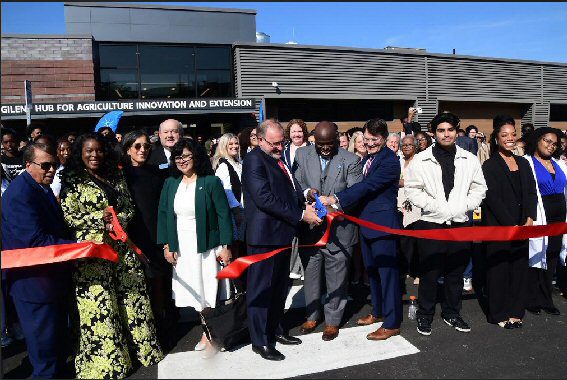
(center) Retired Agilent CEO Mike McMullen, DSU President Tony Allen, and DNREC Secretary Gregory Patterson cut the ribbon on DSU new Agilent Hub for Agriculture, Innovation, and Extension building. On the left, Dover Mayor Robin R. Christensen and DSU College of Ag, Science and Technology Dean Cherese Winstead take session to the other end of the ribbon / Image courtesy DSU
A new building at Delaware State University in Dover – the Agilent Hub for Agriculture, Innovation and Extension. The ribbon was cut on this 10,500 square foot building Monday. It will expand the University’s capacity for research and Innovation thanks to a partnership with Agilent Technologies and the USDA. In three years, Agilent has invested $10-million in DSU’s College of Agriculture, Science and Technology – including $4-million in scholarships, $5-million in instrumentation and $1-million for the first endowed professorship at DSU.
Additional information from DSU:
DSU President Tony Allen shared his excitement over the partnership between the University and Agilent Technologies. “We generally have longstanding great relationships with companies, but sometimes a company comes in and asks, ‘What can we do and how fast can we do it’,” Dr. Allen said. “Agilent – under the first leadership of retired CEO Mike McMullen and Sally Frank – in three short years has invested $10 million in DSU’s College of Agriculture, Science and Technology, including $4 million in scholarships, $5 million in instrumentation, and $1 million for the first endowed professorship at DSU.”
Dr. Allen added that the University now has the best instrumentation in the country – much of which will be installed in the Agilent Hub – because of Agilent Technologies.
Dr. Cherese Winstead, Dean of the College of Agriculture, Science and Technology, noted that the construction of the Agilent Hub was also supported financially by $7.6 million from the USDA National Institute of Food and Agriculture (NIFA) and $1.5 million from the State of Delaware.
“The physical infrastructure of HBCUs and minority-serving institutions is sometimes deferred, so we are challenged in this area. Not many federal agencies will put forth the dollars to make an investment in your physical infrastructure for your student training, research and extension,” Dr. Winstead said. “If you think about the millions and millions of dollars USDA NIFA pours into 1890 Land Grant schools, it is USDA NIFA that made this day happen for DSU for our physical infrastructure.”
Dr. Winstead noted that the Agilent Hub has come into being as a result of the private-public partnership between Agilent Technologies, the USDA and DSU. “And that physical infrastructure investment is met by the research infrastructure investment by Agilent,” she said.
During the ceremony, about 20 Agilent Scholars who are benefiting from scholarship support from Agilent Technologies were brought before the large gathering as proof of the impact of the federal and corporate partnership.
Dr. Rubella Goswami, USDA Deputy Director, said her agency’s contribution is intended to help 1890 Land Grant institutions such as DSU develop the next generations of leaders in food, ag, and innovation. “It is so heartening to see the next generation of leaders here and hear about our students doing so well,” she said.
Dr. Goswami noted that DSU has received $70 million since 2015 in USDA competitive and capacity grants, and in 2025 the USDA has invested $232 million in 1890 Land Grant institutions. “So that shows our faith in these partnerships,” she said.
Delaware Secretary of Agriculture Donald Clifton said while his career has included stints with the USDA and the Delaware Farm Bureau that has led to his current cabinet post, he is “first and foremost” a farmer.
“I am a consumer of the research that is done in a facility like this, a consumer of the knowledge that can be applied on the ground to assist us in our production techniques and how we can safely product crops not only for us but for the health and safety of the public,” Secretary Clifton said.
What is going to be done here is not only going to have impact on this University, but on the nation and globally as well. We don’t know what we don’t know. But we soon will know.”
Gregory Patterson, Secretary of the Delaware Department Natural Resources and Environmental Control, said he is very interested in the research that will take place in the new facility.
“Farmers are environmentalists, and their livelihood and our food depends on environmental stewardship. And that environmental stewardship depends on research, innovation, and best practices that are continually evolving and continually facing new challenges,” Secretary Patterson said. “That will require the work that will go on (in the Agilent Hub).”
Delaware State University is one of nineteen 1890 Land Grand institutions of higher education in the U.S. which as HBCUs provide innovative, research-based programs that empower, uplift and educate diverse students and underserved communities, while at the same time apply their
expertise to address the challenges facing agriculture and food supply issues. The new Agilent Hub for Agriculture, Innovation, and Extension further fulfill the University’s commitment to serve well as an 1890 institution.