Gov Meyer Signs Proclamation to Mark National Domestic Violence Awareness Month
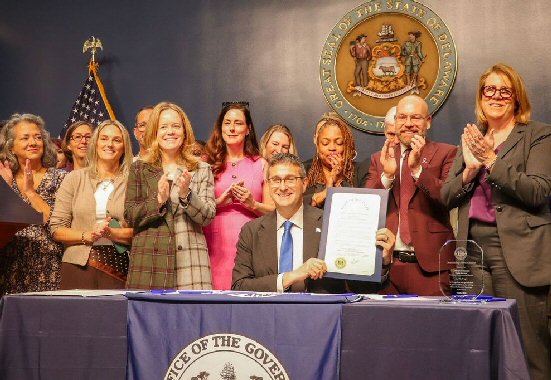
Image courtesy delaware.gov
Governor Matt Meyer marked the start of National Domestic Violence Awareness Month by signing a proclamation and ceremonially signed five bills that strengthen protections for survivors of domestic and sexual violence in the First State. These bills all make it easier to keep people safe. The five bills were signed into law on September 14, but Monday’s ceremonial signing recognized the work of survivors, advocates and legislators who helped advance additional protections for Delawareans experiencing domestic and sexual violence.
The five bills that were ceremonially signed:
- House Bill 122 – refines and clarifies the criminal jurisdiction of Family Court, including by removing the requirement that both parents be Delaware residents from the definition of family. The law also provides concurrent jurisdiction to Family Court and the Court of Common Pleas for relevant non-felony adult criminal cases.
- House Bill 213 – creates a privilege protecting confidential communications between victims and qualifying victim advocates. The protection is designed to allow survivors to communicate with advocates while establishing specific exceptions, including for mandated reporting.
- House Bill 342 – extends Delaware’s prohibition on purchasing or possessing deadly weapons to individuals subject to qualifying protective orders issued outside Delaware. The law closes a gap that previously limited the prohibition to Family Court protective orders.
- House Bill 421 – establishes clearer criteria for sexual violence protective orders. The law prohibits Superior Court from denying an order based on factors including voluntary intoxication, limited consensual sexual touching or a survivor’s decision not to report non-consensual conduct or threats to law enforcement.
- House Bill 355 – known as the Speak Your Truth Act, provides additional protections against retaliatory defamation lawsuits involving disclosures about sexual assault, harassment or discrimination. The law also includes provisions related to attorney fees and damages when a covered individual successfully defends against a defamation claim.
Additional information from Gov Meyer:
Joined by Attorney General Kathy Jennings, Family Court Chief Judge Michael Newell, Representative Krista Griffith, Representative Eric Morrison, advocates and victim service providers at the Carvel State Office Building, Governor Meyer highlighted legislation passed this year that strengthens confidentiality for survivors, closes gaps in protective orders and gives survivors greater protection when speaking about their experiences.
“Domestic violence is often hidden behind closed doors, but the responsibility to end it belongs to all of us,” said Governor Matt Meyer. “These laws make it safer for survivors to ask for help, seek protection and speak their truth without fear of retribution or punishment. To every survivor who found the courage to speak out and to every advocate who stood beside them when they needed you: we see you, we thank you and we have your back.”
“All of the bills signed today have one thing in common: making it easier for us to keep people safe,” said Attorney General Kathy Jennings. “This package of legislation does so by increasing confidentiality for victims and making it easier for them to secure protection orders, changes that will make a world of difference for those who have already suffered incalculably. I’m grateful to our Governor, to the bill’s sponsors in the General Assembly, and to the countless partners and advocates who have worked diligently to enshrine this legislation into law.”
“Domestic violence survivors have experienced unimaginable trauma, and here in the First State, we’re reinforcing our laws to further uphold victims’ rights and the pursuit of justice,” said Senator Nicole Poore, prime Senate sponsor of HBs 122, 213, 342, and 421. “With this package of bills, we’re guaranteeing that victims receive the support they need, while further protecting them from the thralls of abuse.”
“Delaware should never stop refining the tools the state needs to end domestic violence. It is the least we can do to help survivors get justice for the abuse committed against them and protections to prohibit the trauma from happening again,” said Rep. Griffith. “We are so fortunate in Delaware to have advocates on the front lines of violence to vigorously find ways to improve our laws. In doing so, Delaware will be safer for survivors to seek help and leave often lethal situations with their intimate partners.”
“It takes a lot of courage for survivors to come forward and share their experiences, and no one should have to worry that speaking honestly about what happened to them could create another source of harm,” said Rep. Eric Morrison, sponsor of HB 355. “I was proud to sponsor the Speak Your Truth Act, which gives survivors clear protections under Delaware law when they choose to speak about their experiences of sexual assault. I’m grateful to see this legislation signed into law and hope that it gives survivors more confidence that they can speak their truth without fear of being punished for doing so.”
The five bills were sponsored by Senator Nicole Poore, Representative Griffith and Representative Morrison and became law following Governor Meyer’s signature on September 14. The ceremonial signing recognized the work of survivors, advocates and legislators who helped advance additional protections for Delawareans experiencing domestic and sexual violence.
Governor Meyer also signed a proclamation recognizing October as Domestic Violence Awareness Month in Delaware and called on Delawareans to recognize that ending domestic violence is a shared responsibility.
During the ceremony, Department of Correction Commissioner Terra Taylor, on behalf of the Domestic Violence Coordinating Council, presented its Outstanding Service Award to Lindsay Beiler, a victim services specialist with the Delaware Department of Justice. Before joining DOJ, Beiler worked with the Division of Family Services on cases involving child abuse and child sexual abuse. She currently works in DOJ’s Special Victims Unit with victims of sexual abuse, child abuse and domestic violence as well as families affected by child deaths and homicides.