
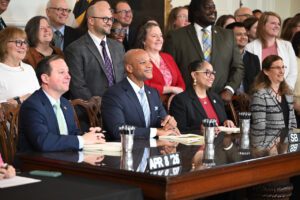
Governor Wes Moore signs the FY2027 Budget into Law
He says he has repeatedly emphasized that public safety remains the top priority, pointing to a record $124 million investment in local law enforcement agencies across Maryland.
Prior to Governor Wes Moore signing the FY 2027 budget into law this morning, he talked about how the budget addresses the issue of rising energy prices high utility bills…
He said this budget puts 100 Million dollars back into peoples’ pockets through utility fee relief.
Highlights in the enacted budget include high quality child care and fighting child poverty…
He says these child care investments are amongst the largest in the United States.
Additional Information from the Office of Governor Wes Moore:
Governor Wes Moore today signed the Fiscal Year 2027 state budget into law, delivering on key commitments to make Maryland more affordable and competitive while securing historic investments in education and public safety. The budget, which passed with bipartisan support from the Maryland General Assembly, includes no new taxes or fees, maintains the state’s Rainy Day Fund at 8%, increases the state’s Fund Balance to $250 million, and has General Fund expenditures smaller than the Fiscal Year 2026 General Fund budget.
“A budget is more than numbers on a page,” said Gov. Moore. “It tells our people what matters, it tells our people who we are fighting for, and it tells people whether we are willing to make hard decisions and still deliver. This budget protects our people, makes life a little more affordable for our people, and strengthens Maryland’s economic competitiveness. Together with our partners in the General Assembly, we said what we were going to do, and we achieved it.”
“Today’s bill signing is about delivering a state budget that reflects both discipline and direction, and does not lose sight of Maryland’s future,” said Senate President Bill Ferguson. “From the very beginning of January, we were clear-eyed about the challenges in front of us. Maryland families are feeling economic pressure from this federal administration. Despite that, this budget reflects balance, protecting what matters most today and investing in tomorrow.”
“This budget reflects what’s possible when we put Marylanders first—bringing together Democrats and Republicans from every region of the state to make responsible choices that strengthen our economy, support working families, and invest in our communities,” said House Speaker Joseline Peña-Melnyk. “We tightened our belt where needed, but never lost sight of our commitment to opportunity, affordability, and long-term stability. We are meeting this moment with discipline and purpose, while ensuring Maryland remains a place where people can live, work, and thrive.”
Highlights in the enacted budget include:
Lowering Costs for Marylanders
- Lowering the Cost of Energy: Historic $306 million in funding for renewable and clean energy programs in the Maryland Energy Administration. Drawn from the Strategic Energy Investment Fund, the budget also includes funding to support lower utility bills, invest in clean energy infrastructure, and research on energy resiliency. The budget also includes $100 million in utility fee relief.
- Fighting Child Poverty: The budget continues record State funding of $434 million to support the Child Care Scholarship program to help families enroll their young children in high-quality child care and includes a record $32 million investment in community-driven initiatives to tackle child poverty in neighborhoods with the highest concentrations of poverty through the ENOUGH Initiative.
- Revitalizing Communities: $73.7 million to fund more than 250 projects through the six state revitalization programs administered by the Maryland Department of Housing and Community Development. Of the $73.7 million, more than $45 million are to projects in Just Communities across Maryland—identified through data and history where the state is intentionally directing investment to repair past harms, reduce disparities, and create equitable opportunities for residents.
Protecting Our People
- Record Funding for Law Enforcement: A record $124.1 million in funding to support law enforcement through the State Aid for Police Protection Program, representing the Moore-Miller Administration’s continued commitment to making Maryland safer, as the state continues to see historic drops in violent crime.
- Expansion of Community-Based Programs to Serve Justice-Involved Youth: Invests $10.6 million for the Department of Juvenile Services, bringing total investments to $30 million, to expand results-driven programs like Safer, Stronger Together and the Thrive Academy.
- Support for Correctional Facilities Improvements: More than $35 million to help support maintenance and operations for aging Department of Public Safety and Correctional Services facilities, including Department of Juvenile Services facilities.
Increasing Maryland’s Economic Competitiveness
- Historic Investment in K-12 Education: The administration’s $10.1 billion investment in education reflects a more than $370 million increase over FY 2026, the investment represents a nearly 17% increase in overall K-12 funding since the start of the Moore-Miller Administration. The governor’s enacted budget provides:
- $228 million in K-12 aid above statutory formulas;
- $10.9 million to support evidence-based literacy and math coaches in public schools through the Academic Excellence Program;
- $480.5 million in state funding for school construction to modernize aging facilities and expand capacity;
- $19.4 million to sustain the administration’s work to reduce the state’s teacher vacancy rate;
- $572 million to support Community Schools—a 16% increase from FY 2026— to provide more than half of Maryland schools with wraparound student and family support services.
- Diversifying Maryland’s Economy: The budget supports turning away from Maryland’s long term economic reliance on the “eds, feds, and meds” including more than $100 million in targeted and tested business tax cuts and strengthening Maryland’s capacity to drive private investment.
- Making Maryland the Capital of Quantum: Maryland has secured well over $500 million in quantum investments since launching the initiative and welcomed new companies like Microsoft’s Quantum Research Center to Maryland. The budget includes:
- $20 million as part of a multi-year $50 million commitment to construct IonQ’s new headquarters in College Park, Maryland;
- $22 million for University of Maryland Enterprise Corporation to expand the Quantum Start-Up Foundry and provide funds for Quantum Test-Beds, including the National Quantum Lab and $20 million for a Deep Tech Facility in the University of Maryland Discovery District;
- $12 million to support Capital of Quantum in Prince George’s County to recruit faculty experts at the University of Maryland, and technical and evaluation experts at the Applied Research Laboratory for Intelligence and Security, known as ARLIS.