
The Delaware Court of Chancery Announces 3rd Annual Student Legal History Art Contest
The Delaware Court of Chancery has announced the 3rd Annual Legal History Art Contest for Delaware students in grades 7 to 12. As in years past, winners of the contest will receive $500 for first place, $300 for second place, and $200 for third place. All submissions must be received by April 25th, 2025.
Full details are on the court website https://courts.delaware.gov/
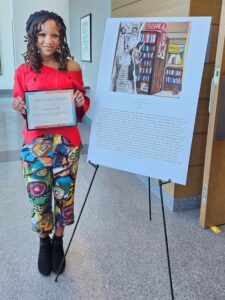
photo of last year’s winner student, Amaurie Yip of Middletown High School, with her winning piece titled “Torn Remembrance”.
Additional information From the Delaware Court of Chancery
The Delaware Court of Chancery is proud to announce its third annual Legal History Art Contest,
open to Delaware students in grades 7-12, to honor the 1952 Court of Chancery rulings in Belton
v. Gebhart and Bulah v. Gebhart ordering the desegregation of two Delaware public schools. In
1954, the United States Supreme Court affirmed these rulings in the landmark case Brown v. Board
of Education.
The art contest, which is being conducted in partnership with the Court of Chancery Historical
Society, invites students to submit works representing these historic cases and their impact. Student
participants are asked to create art depicting their impressions of these important court cases,
including people or places that were featured in the decision including litigants, judges, lawyers,
or locations such as the schools or towns. Participating students can submit their art digitally by
email. All submissions must be original artwork by the student and e-mail submissions must
include the student’s full name, email, phone number, grade, title of artwork (optional) and how
the artwork addresses the theme. All submissions must be received by April 25, 2025.
Winners of the contest will receive $500 for first place, $300 for second place, and $200 for third
place. In addition, the winning students and their families will be invited to attend a reception and
award ceremony.
Early submissions are encouraged and full details, including the form needed to submit for the contest, can be found on the court’s website at https://courts.delaware.gov/chancery/art-
competition.aspx.
See below for more details on Belton v. Gebhart and Bulah v. Gebhart.
Amidst the backdrop of segregated Wilmington in the early 1950’s, African American parents
challenged state-enforced segregation by fighting to have their children be able to attend their local
white schools. In Belton v. Gebhart, high school student Ethel Louise Belton was forced to travel
two hours daily to a school with inferior and unequal academic offerings. In Bulah v. Gebhart,
Shirley Bulah was not allowed to ride the bus that passed by her house with the white children
every day and was prevented from attending her local public school due to her race. Both Belton
and Bulah were represented by Louis L. Redding, Esquire, Delaware’s first African American
attorney.
On April 1, 1952, then Chancellor Collins J. Seitz (father of current Delaware Supreme Court
Chief Justice Collins J. Seitz, Jr.) of the Delaware Court of Chancery delivered the opinion in the
action consolidating Belton and Bulah, concluding that segregation caused African American
children, as a class, to receive “educational opportunities which are substantially inferior to those
available to white children otherwise similarly situated.” Chancellor Seitz also noted: “The
application of Constitutional principles is often distasteful to some citizens, but that is one reason
for Constitutional guarantees. The principles override transitory passions.” Two weeks later, he
ordered the desegregation of the two schools at issue in the case, Claymont High School and
Hockessin School No. 29. Belton and Bulah were later part of the consolidated litigation leading
to the 1954 decision in Brown v. Board of Education where the United States Supreme Court
declared the “separate but equal” doctrine unconstitutional.