
Gov Meyer Signs HB 268 & Delaware Takes Major Step Toward Next Generation 911
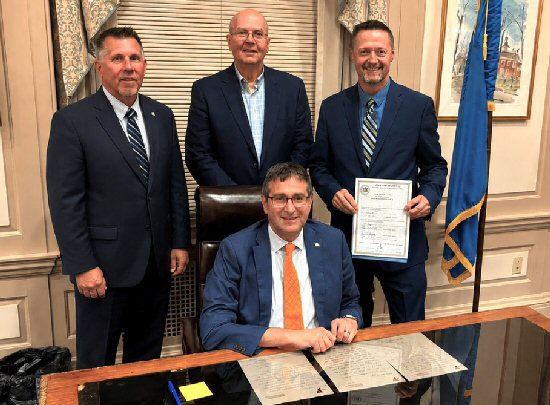
L-R: Director of Communications Director Eric Wagner, 911 Emergency Services Board member Michael Vincent, E911 Director Robert Williams, and Governor Matthew Meyer (center) / Image courtesy DSHS
Legislation establishing a sustainable funding source to transition Delaware’s legacy emergency communications network to a statewide Next Generation 911(NG911) system has been signed by Governor Matt Meyer. House Bill 468 was passed with unanimous bipartisan support and will give first responders and emergency communications professionals the modern technology needed to better serve Delawareans. Beginning October 1st, the monthly 911 surcharge will increase from 60 cents to 90 cents – the first increase since 2001. This extra revenue will fund the infrastructure, equipment, software, cybersecurity, and training needed to deploy and maintain a modern statewide emergency communications network.
Additional information from the DE Department of Safety & Homeland Security:
Sponsored by Rep. William Bush and co-sponsored by Rep. Daniel Short and Sen. Nicole Poore, House Bill 468 passed unanimously with bipartisan support. Beginning Oct. 1, 2026, it increases the monthly 911 surcharge from 60 cents to 90 cents—the first adjustment since 2001. The additional revenue will fund the infrastructure, equipment, software, cybersecurity, and training needed to deploy and maintain a modern statewide emergency communications network.
Rep. William Bush (D-29), primary sponsor of House Bill 468, stated, “Having worked with Delaware’s fire, EMS, and law enforcement communities throughout my career, I know that reliable emergency communications are critical to protecting lives. This legislation will help modernize Delaware’s emergency communications network, so we’re prepared not only for today’s emergencies but for the challenges of tomorrow.”
“911 emergency services play a critical role in coordinating life-saving services for people during some of the most stressful moments of their lives. As technology evolves, it’s important that we modernize our systems to ensure that Delawareans receive the fastest, most reliable emergency assistance when they need it most,” said Sen. Nicole Poore (D-12), lead Senate sponsor of House Bill 468. “This legislation will help us support these vital emergency services while opening up avenues to life-saving technology like text-to-911 and improved geolocation detection, which will help our first responders serving on the front lines.”
“While the cost to Delaware households is minimal, I believe the benefits gained from next-generation 9-1-1 communications will be immeasurable,” said Rep. Daniel B. Short (D-39). “This investment will modernize our emergency communications system, equipping first responders with capabilities that improve response times, enhance situational awareness, and ultimately save lives, far outstripping the modest cost of implementing these new technologies.”
“Every second matters when someone reaches out to 911 for help,” said Department of Safety and Homeland Security Secretary Joshua Bushweller. “This legislation gives Delaware the resources to build a more resilient, secure and technologically advanced emergency communications system. By investing in Next Generation 911 today, we’re ensuring our dispatchers and first responders have the tools they need to respond quickly, share more information and better protect the people of Delaware.”
Delaware’s emergency communications professionals answer more than 700,000 voice 911 calls and process at least 20,000 text-to-911 messages each year. The statewide system includes eight Public Safety Answering Points (PSAPs), staffed by approximately 300 telecommunications specialists who provide 24-hour emergency dispatch services.
NG911 will replace Delaware’s legacy Enhanced 911 (E911) system with a secure, internet protocol-based network that supports voice calls, text-to-911 and multimedia such as photos and videos. It will also improve caller location accuracy, strengthen data sharing with first responders, and enhance system resiliency during emergencies.
Revenue generated through the updated surcharge will be deposited into the state’s 911 System Fund and used exclusively for eligible NG911-related expenses, including:
- Modern network infrastructure and connectivity
- Call-handling equipment and software
- Cybersecurity and GIS data management
- Training, system operations, and maintenance
- Public education, language translation and other eligible NG911 expenses
The surcharge has remained unchanged since 2001 despite rising technology and operating costs. The legislation is expected to generate approximately $3.375 million in FY2027 and about $4.5 million annually thereafter, supporting Delaware’s statewide transition to NG911. For most Delawareans, the increase amounts to 30 cents per month per covered communications line.
ABOUT DELAWARE E911
The mission of Delaware E911 is to protect and enhance public safety and health by facilitating the operation and maintenance of efficient state-of-the-art Enhanced 911 (E911) services in the State of Delaware. This includes a comprehensive State Plan that includes wireless E911. The State’s E911 Board also develops standards and uniform policies and procedures for all E911 Centers, appropriates available funding to implement, maintain, and improve the State E911 System, and ensures that all users receive compassionate and professional emergency services from a well-trained and highly skilled work force. E911 also ensures the compliance of providers with state and federal 911 statutes and regulations and provides information to Delaware citizens on the capabilities and proper use of the E911 System.