
Legendary Fighter Takes Final Flight: Dover Air Force Base C-5M Delivers F-117A to Smithsonian
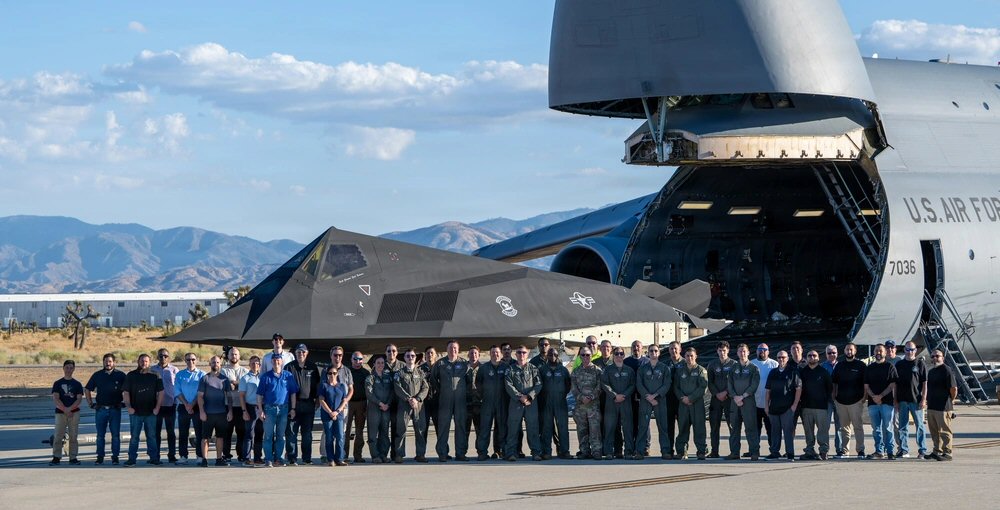
Airmen assigned to the Air Force Reserve’s 512th Airlift Wing pose with personnel from Lockheed Martin, Air & Space Forces Magazine and the Smithsonian Institution for a photo in front of a wingless F117A Nighthawk before it is uploaded to a C-5M Super Galaxy in Palmdale, Calif., Oct. 5, 2026. The demilitarization process required to deem an aircraft worthy of museum display requires immense cooperation between the Department of War and its industry partners / US Air Force photo by Staff Sgt. Alexis Morris
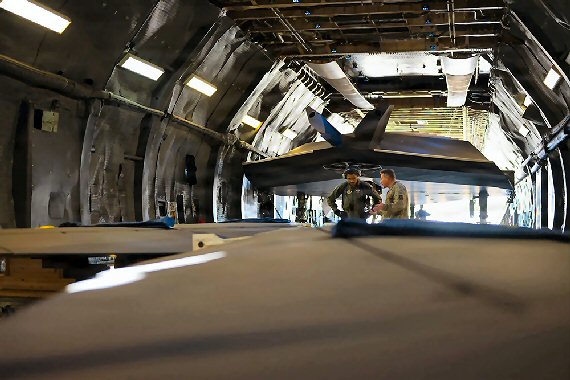
Tech. Sgt. Ryan Vaina, right, and Airman 1st Class Preston Pierce, 709th Airlift Squadron loadmasters, have a conversation within the cargo hold of C-5M Super Galaxy prior to takeoff from Palmdale, Calif., Oct. 6, 2026. The two discussed the securement strategy of two F-117A Nighthawk wings during a high-visibility mission / US Air Force photo by Staff Sgt. Alexis Morris
A C-5M Super Galaxy from Dover Air Force Base recently carried a retired F-117A Nighthawk from Palmdale, California to the Smithsonian Institution’s National Air and Space Museum’s Steven F. Udvar-Hazy Center in Chantilly, Virginia where it will join the institution’s permanent collection.
The F-117A was retired by the US Air Force from combat nearly 20 years ago. This stealth fighter, named “Overachiever” was the only F-117A to fly in all four major conflicts in which Nighthawks flew combat operations – Just Cause, Desert Storm, Allied Force and Iraqi Freedom. It was retired in 2007.
Additional information from the US Air Force:
The two-day, cross-country mission required precise weight distribution and millimeter-level clearances to fit the 29,500-pound load into the C-5M’s cargo compartment. For the 512th Airlift reservists from Dover, executing high-consequence, strategic airlift operations is business as usual – even when the payload is a piece of aviation history.
“Growing up in the ‘90s and 2000s, I remember thinking of the F-117 as the most unique plane,” said Maj. Billy Hafker, 709th Airlift Squadron instructor pilot and aircraft commander for the mission. “Being able to move it to the Smithsonian to preserve it for future generations is an incredible opportunity, and we’re all honored to do it.”
Cargo-bearing missions in the Super Galaxy require mission-ready Airmen from various career fields spanning from flying crew chief to pilot, according to Hafker. Each Airmen’s proficiency in the generation and sustainment of airpower ensures the Air Force Reserve is ready to move fast, think creatively and disrupt the status quo when reacting to crises on the global stage.
Upon landing in Palmdale, California, the Dover-based crew began conducting pre-loading operations to stage the aircraft for cargo. Within two hours of landing, the loadmasters had carefully maneuvered and secured the detached Nighthawk’s wings into the cargo hold while maintaining ample room for the fuselage.
However, the F-117’s cockpit upload was unexpectedly delayed overnight due to a coordination breakdown regarding the required number of tie-down points on the fourth-generation fighter. With both aircraft grounded on the tarmac, the Lockheed Martin Skunk Works mechanical team worked through the night to resolve the issue. Their efforts to fabricate and install the points ensured the entire plane was successfully delivered to the Smithsonian team on October 6.
“It was a little difficult to load in, but we got the job done,” shared Senior Airman Lucas Richard, 709th Airlift Squadron loadmaster. “This is probably one of the coolest pieces of cargo that I’ve ever seen.”
As of January 2021, the Air Force has retained approximately 48 F-117As in its inventory and has disposed of approximately four aircraft each year since grounding the fleet in April 2008. The demilitarization process required to deem an aircraft worthy of museum display requires immense cooperation between the Department of War and its industry partners.
“There’s a lot of people that participate in a project like this,” said Jeff Corbets, program manager at Lockheed Martin Skunk Works, who led the restoration. “Demilitarization was the most difficult piece, but I think it went really smoothly, all things considered.”
As the historic aircraft takes its place on the museum floor to be marveled by more than a million visitors each year, the mission itself serves as a proud victory for the 512th AW and its C-5 squadron. Beyond preserving history, the operation successfully showcased the advantage of the Air Force Reserve in action – delivering unprecedented combat capability and professionalism to the Joint Force.